| |
| New |
Automation for Marble Polishing Machine - Fidko installed PLC controlled automation for a marble polishing machine in "Mermeren Kombinat" - Prilep...
Read more |
Rectifiers for batteries - Fidko produces regulated chargers for rechargeable batteries that provide charging and maintaining of the batteries according to the desired feature.
Read more |
MB-600 - Fully automatic flour packing machine
Read more |
SCADA system - Fidko has fully automated the conveyor transport system in "Skopski Leguri" and installed a SCADA system which enables better control, efficiency, reliability...
Read more |
|
Computer numerical controlled Punching Machine
 |
Our engineering team made a full reconstruction and replacement
of automatic unit and computer system of a Trumatic 180 machine
in the factory EMO – Ohrid. This machine is a CNC (Computer numerical
controlled) Punching Machine for punching metal plates, up to 6
mm thickness with regulated movement in two direction through X
and Y axes.
The working area is 2000x1300 mm. The movements are made with hydraulic
and pneumatic units.
The machine can operate on two modes: by punching a single hole
in metal plate or punching continues lines or arc segments. The
second mode is used for drawing continues irregular forms by combing
line and arc segments.
In this project we solved the following problems:
-
Replacement of the automatic unit with electrical modules
and Programmable Logical Controllers (PLC) with touch screen
Human Machine Interface (HMI) and interfaces modules.
-
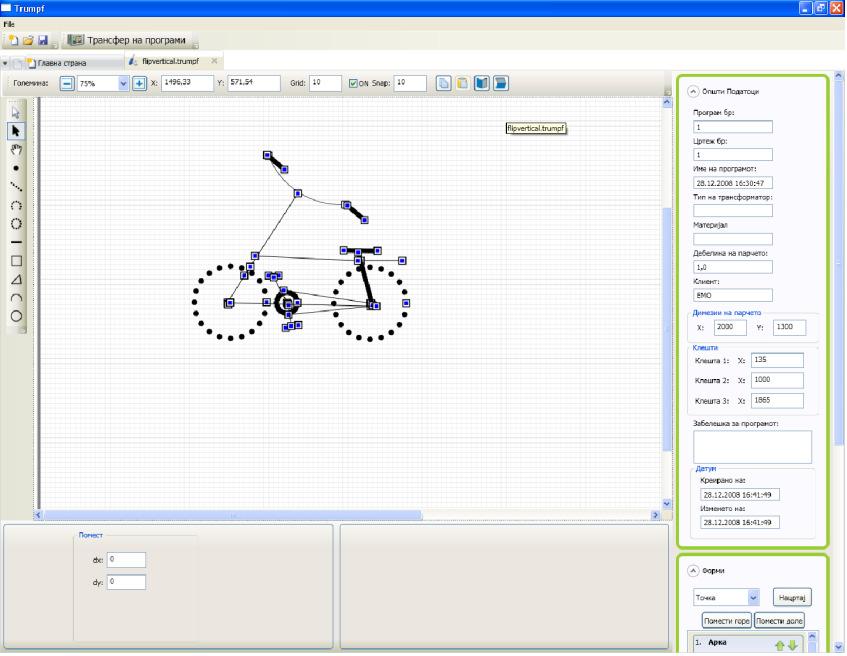
Replacement of the old computer system for defining drawings
with modern system with implemented wireless communication with
the PLC and a modern software application with build in vector
graphics editor.
|
Automation:
  |
For the direction of the axes the control is performed by the
PLC unit from our vendor Unitronics.
The PLC unit is modern model with touch screen HMI. It has an option
for inserting external SD memory card. We used this future to raise
the number of stored programs with drawings. in the PLC.
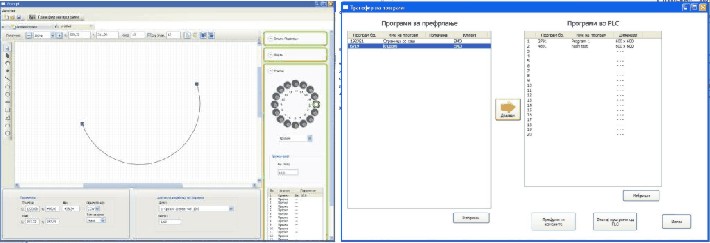
The communication between the PLC unit and PC is made on demand.
This communication is initiated by the computer for the following
reasons:
- Transfer of a program with a 2D drawing to the PLC memory
- Reading the status from PLC memory
- Deleting or managing the programs stored in PLC memory
The communication is provided by a router placed near the machine,
which wireless communicates with the computer and is connected
with an Ethernet cable with the PLC unit.
The worker can chose two working modes on the machine: automatic
or manual. The manual is used only for intervention during the execution
of an automatic program or for some corrections or calibration of
the machine.
During the execution of an automatic program, the worker has full
watch on the step of execution on the punching and moving of the
punching head of machine.
Alarms are defined for warning, for ensuring from action with unwanted
consequences. Also are included preventive mechanisms for disabling
the machine to make unwanted activities.
|
User software application:
|
|
For providing easy creation of 2D drawings of standard forms,
the Fidko engineering team developed custom application software
with:
- build in vector graphics editor
- module for conversion of drawings to steps familiar to the
PLC unit and
- module for transferring those steps to the PLC.
The graphics editor has two modes of drawing. One with the mouse
with clicking on predefined handle points, and the other with inserting
parameter values for the forms. For example, the arc has following
parameters: start and end point, radius, drawing orientation, tip
of arc – small of large. Also the user can define drawing precision,
continuous drawing for complex forms and order of form execution.
For every form the user defines the corresponding tool with witch
the form is made. The machine has 16 slots for different tools.
As we mentioned before, the user can draw complex irregular forms
by combining predefined elementary forms. The software is made for
providing easy and fast production of drawings to the user and to
restrict machine and material damage. That makes this application
a useful and a rational tool for this type of machines.
|
|